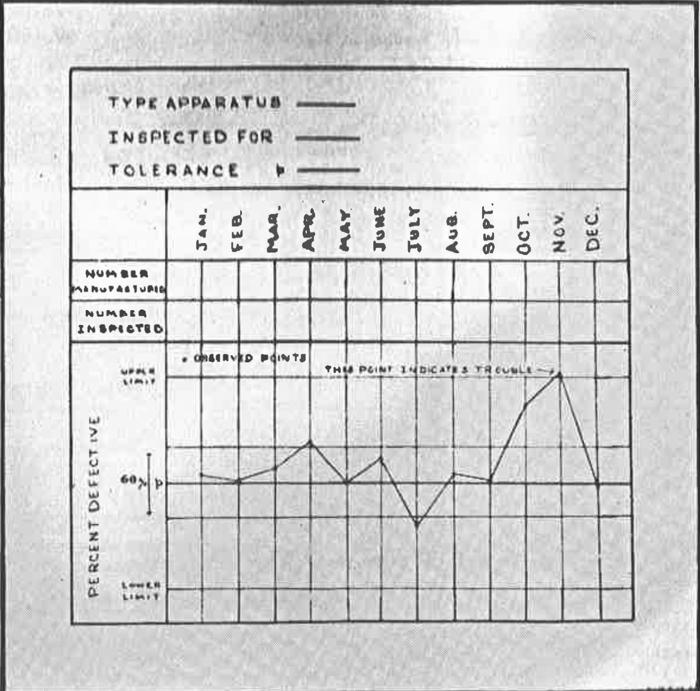
In our first posts on the history of quality, we discussed Frederick Winslow Taylor, who pioneered process standardization and optimization in the early 1900s, and Walter Shewhart, who invented statistical process control in the 1920s. Today we consider W. Edwards Deming, who was an intern at the Cicero, IL factory where Shewhart wrote his famous memo. Deming advanced our understanding of quality by recognizing the importance of effective management and systemic thinking.
Deming adopted and extended Shewhart's ideas in his work with the 1940 US Census and as part of the team that developed the American War Standards in 1942. Post-war he worked with General Douglas MacArthur on planning for Japan's census, where the Union of Japanese Scientists and Engineers invited him to teach statistical process control to their members. Japanese businesses applied these techniques with great success.
Deming continued his work as a consultant, famously helping Ford Motor Company pivot from loss to profitability with his focus on management. He published his methods in 1982 in a book titled Quality, Productivity, and Competitive Position, later renamed Out of the Crisis and, still later, modestly recast as the System of Profound Knowledge. Whereas Taylor's magnum opus was chock-full of folksy classism, and Shewhart's was basically a statistics textbook, Out of the Crisis pinballs from Bible verses ("My people are destroyed for lack of knowledge") to exhortations ("Western management must awaken to the challenge, must learn their responsibilities, and take on leadership for change") to listicles ("b. Put resources into: 1. Research 2. Education") to anecdotes ("As an example, I may cite a proposed itinerary in Japan...Only one minute to change trains? You don't need a whole minute.") It's a wild ride!
The book is centered on 14 principles for transformation of American industry, which can be distilled as follows:
- Aim to improve products and services continuously - if quality is improved, profitability will follow.
- Build quality into products, rather than relying on inspection to identify defects.
- Form trusted partnerships with a single supplier for each item.
- Break down barriers between departments so they can work together as a single team, thinking systemically.
- Invest in training and education.
- Eliminate external motivators for productivity, such as management by objective, quotas, and merit ratings; lead rather than manage by taking a systemic approach to quality, rather than focusing on individual performance.
To emphasize that quality is a product of the system rather than individual performance, Deming used the Red Bead Experiment, a combination of exercise and role play in which six subjects were trained to use a tool to extract beads out of a pan that held 80% white beads and 20% red beads. The subjects were told that the object was to extract as many white beads as possible; the number of "defects" (red beads extracted) were tallied and the subjects' performances compared. Throughout the exercise the leader role-plays management's response to reward and punish subjects according to their performance and to assign meaning to actions that are the result of chance. Deming made several points regarding this experiment:
- Standards, training, and motivation are useless if the system is not set up to maximize quality.
- Individual performance is not always the reason for variation in a process.
- A process can be stable (in other words, the number of red beads drawn can be within predictable limits) and still produce more defects than are acceptable to the business.
So how do we improve our systems? By constant innovation. Deming popularized the Plan - Do - Check - Act cycle, which he called the Shewhart cycle. In clinical research we tend to perceive the Shewhart cycle as an SOP (write a process, execute the process, perform a quality control review to see what went wrong, make improvements). Deming presented the cycle more as a series of experiments: plan an improvement, try it out, measure the results, then implement it - or try something else.
It's interesting to consider Deming's lessons in the context of the sponsor/CRO relationship. We'll revisit this in future posts.
Meanwhile, you can buy your own Red Bead Experiment Kit from this company for $95 US dollars (yikes). Or better yet, buy two packages of beads for about $12, and use the leftover beads to make friendship bracelets, just like Taylor.