Next in our series of The Future of GCP QA, we look at the Lean Six Sigma methodology for quality improvement, which grew out of two separate movements, Lean and Six Sigma.
The Lean philosophy arose from The Toyota Way, Toyota's system for just-in-time manufacturing, which strives eliminate waste, including the waste of having raw materials and products in inventory; the waste of producing more features than customers have demanded; the waste of transportation; the waste of excess motion; the waste of inactivity; and the waste inherent in defective products. To achieve this state, Lean organizations identify the value in their product; map the "value stream" that creates the value in the product; and revise processes to eliminate the wastes within the value stream. The Agile methodology used in software development is a direct descendent of Lean.
Six Sigma, frequently satirized on the old (but still funny!) TV show "30 Rock," was introduced in the 80s at Motorola and also focuses on eliminating the waste involved in product variation--a concept you'll recognize as Shewhart's theory of statistical process control. A simple way of determining upper and lower control limits is to calculate three standard deviations above and below the process average. "Sigma," the Greek letter σ, is a symbol for "standard deviation," and three standard deviations below and three above = six standard deviations, or "Six Sigma."
That's not the only borrowed concept. Six Sigma's process for eliminating waste, known as DMAIC - Define, Measure, Analyze, Improve, and Control - is a reworking of Deming's Plan - Do - Check - Act cycle. And Six Sigma's certification classification - white belt, green belt, yellow belt, and black belt - is of course borrowed from martial arts.
In the early 2000s, an enterprising management consultant decided to slam the two together, Reese's peanut butter cup-style, and invented Lean Six Sigma, which combines the two philosophies.
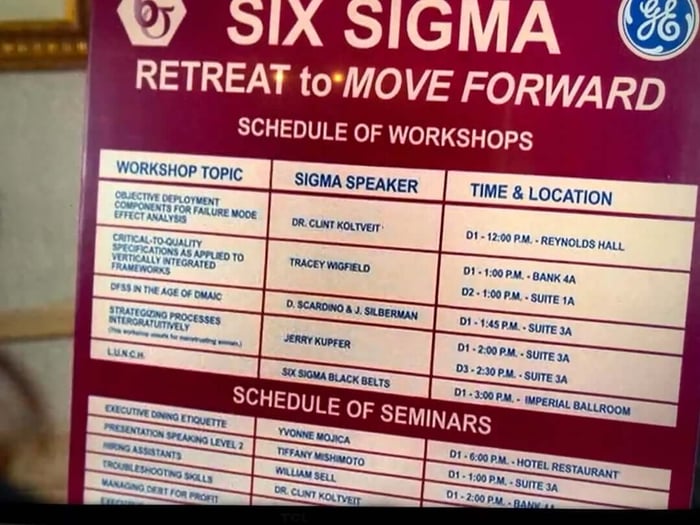
So which Retreat to Move Forward workshop are you attending? I'm tempted by "Critical-to-Quality Specifications as Applied to Vertically Integrated Frameworks," but I may not be able to resist "Strategizing Processes Intergratuitively."