In today's blog post, our History of Quality culminates in the codification of quality management system requirements for pharmaceutical manufacturing: The International Council on Harmonization Quality Guideline Q10, Pharmaceutical Quality System.
Our GCP colleagues are, of course, familiar with the ICH Good Clinical Practice E6. ICH produces four series of guidelines:
- E series, for Efficacy, which deals with clinical trials
- S series, for Safety, for non-clinical trials
- Q series, for Quality, which deals with Good Manufacturing Practice topics
- M series, for Multidisciplinary, for cross-cutting topics
From a GCP perspective, these categories are somewhat confusing, because we think of "Safety" and "Quality" as aspects of clinical trials, while "Efficacy" is only one aspect of clinical trials. It's another reminder that, while we consider clinical research to be the hub of the universe -- like Boston, where so many of us are based! -- the rest of the GXP world views us as a sort of nether region full of strange customs and weird jargon -- again, like Boston.
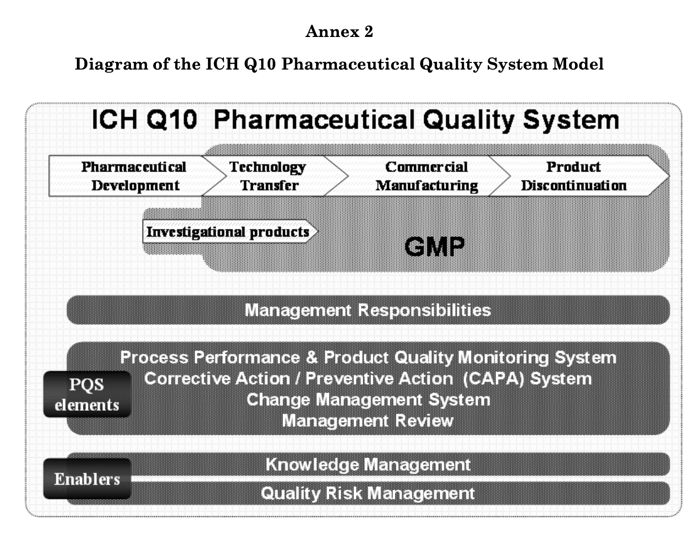
ICH had included information about the role and responsibilities of the Quality Unit in its 2000 Q7 guideline on Good Manufacturing Practice. It covered quality risk management in its 2006 Q8 guideline, Pharmaceutical Development, as well as the 2005 Q9 guideline, Quality Risk Management. In 2008, ICH expanded upon these topics in Q10, Pharmaceutical Quality System. This guideline has not been updated since 2008 and still looks like it was formatted in FileMaker Pro, as evidenced by this fine graphic, which is still being used in slide decks in this, the second quarter of the 21st century:
Doesn't that take you back?
Today we're going to look at the elements of the Pharmaceutical Quality System depicted in this graphic and trace their antecedents back through the history of quality we've covered in this series of blog posts. Then, finally, we'll start looking forward to how this framework has impacted GCP.
- General Management Responsibilities. Per Q10, senior management is responsible for ensuring a commitment to quality; establishing a quality policy; defining and communicating quality objectives; providing sufficient resources; and ensuring effective communication channels. It's giving ISO 9001, but we can trace the importance of management back through Juran and Deming and eventually all the way back to Taylor, who was the first to articulate management's role in guiding processes and methods.
- Supplier Management. The last point in Q10's Management section emphasizes management's role in selecting appropriate suppliers; defining quality activities for suppliers; and monitoring supplier performance and incoming supplies. Again, these principles are drawn directly from ISO but originated with Deming, who emphasized the importance of trusted partnerships with suppliers. We call this out as a separate element because it will be revealed to be important to our application of the GMP quality management system to GMP.
- Process Performance and Product Quality Monitoring System. Q10 states that manufacturers should monitor process performance and product quality to ensure that a state of control is maintained. Monitoring includes quality risk management to establish a control strategy and statistical tools to identify sources of variation. Do we hear Shewhart calling to us across the decades? We do! Q10 also states that teams should include feedback on product quality from both internal and external sources, including complaints, echoing the customer focus of Lean Six Sigma and Juran.
- CAPA System. Per Q10, manufacturers should use a "structured approach" to investigate the root cause of deviations. Did someone say "Ishikawa"? Undoubtedly. The quality management system should include processes for implementing corrective and preventive actions, resulting in product and process improvements. This concept, of course, comes from Deming's Plan - Do - Check- Act cycle, which Deming called the Shewhart cycle, subsequently recycled (see what I did there) into the Define, Measure, Analyze, Improve, and Control (DMAIC) cycle by Six Sigma.
- Change Management. Per Q10, changes should be assessed for risk and regulatory impact. Evaluation criteria for the change should be established. After the change is implemented, the change should be evaluated to confirm that the objectives were achieved and there was no impact on product quality. Change can be understood as the "Act" phase of the Deming cycle or the "Improve" phase of the DMAIC cycle.
- Management Review. Q10 proposes a formal process for management review, which includes review of audit and inspection findings; customer satisfaction; product complaints; process performance and quality monitoring results; and effectiveness of changes. The review feeds back to management's responsibility to guide, enforce, and facilitate the quality management system. See above for the quality antecedents.
- Knowledge Management. Q10 recognizes knowledge management as an "enabler" of the quality management system and defines it as the systematic approach to acquiring, analyzing, storing, and disseminating information. We're going to tag Taylor on this one, but also Zen and the Art of Motorcycle Maintenance. Why not?
- Risk Management. Another enabler, Risk Management, is borrowed from ICH Q9, but has roots in Juran.
At the top of this post, we noted that the Q series of ICH guidelines, although categorized as "Quality," specifically pertains to manufacturing quality. There is no similar E-series guideline that outlines quality management system requirements for clinical trials. So how do these requirements affect GCP? That's next up in this series of posts.